
What Shared Intelligence Changes Across an MGA
November 3, 2026 · Stuart Baserman, CTO of Slice


People manage. AI Agents execute. RiskDNA gives them a shared understanding of the business, so work across underwriting, distribution, servicing, finance and compliance can build on the same evidence.
An AI-first MGA is built around a clear division of responsibility: people manage; AI Agents execute.
People set objectives, risk appetite, authority and success criteria. They assign work, monitor performance, manage material exceptions and evaluate outcomes. AI Agents carry authorized work through to completion, coordinating across functions and using the systems needed to act. Required approvals remain part of that authority.
This changes what shared intelligence needs to do. An underwriting assessment, a service request and a finance query may all concern the same business. Each requires different work, but the understanding behind that work should carry forward.
At Slice, RiskDNA provides the shared risk model. Slice Mind coordinates AI Agent work using that context. Insurance Cloud Services, or ICS, applies configured rules and calculations, executes insurance transactions and maintains operational records.
The following examples illustrate how this operating model connects the MGA's different responsibilities. The scope of execution depends on the product, available evidence and approved systems.
Underwriting: reason over the business's genome
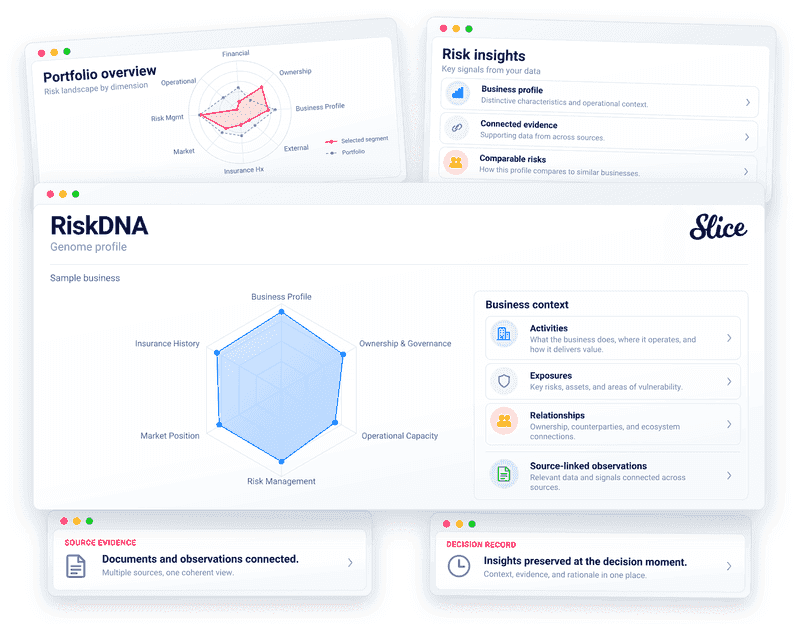
A class code gives an underwriter a starting point. Understanding the business requires more: what it does, how it operates and which exposures those activities create.
RiskDNA organizes named, sourced and dated observations, its genes, into chromosomes. The Business Profile and Operational Capacity chromosomes bring together characteristics such as business identity, work types and subcontractor mix. The depth of that picture depends on the evidence available.
The Exposome adds the context in which the business operates, including coverage, geography, distribution channel and market conditions. The Metabolome represents computed functional state: measures derived from interactions between the business genome and its Exposome, including coherence and complexity.
For a contractor, an underwriting AI Agent could use those layers to examine whether the stated activities, supporting evidence and coverage context fit the approved appetite. Conflicting descriptions would remain visible for investigation.
Underwriting leaders manage appetite, authority and material exceptions. The AI Agent executes the assigned assessment within those boundaries, using shared evidence rather than rebuilding the business from disconnected documents.
Distribution: connect channel context with the actual risk
Distribution manages relationships and the flow of suitable business. RiskDNA's Exposome places distribution-channel context alongside the risk, while Business Profile and Operational Capacity describe the business being brought forward.
That gives a distribution AI Agent a common basis with underwriting for examining appetite fit and identifying missing information. For example, recurring questions about subcontracted work could inform clearer guidance for agencies about the evidence a submission needs.
People manage the distribution strategy, relationships and authority. AI Agents execute authorized appetite checks, information gathering and communication. Agency readiness and individual risk eligibility remain separate decisions, even when they draw on connected context.
Servicing: carry the risk's history into the next action
A business changes during a policy term. The service request is one moment in a longer relationship.
RiskDNA's Temporal Dynamics chromosome captures timing and engagement signals. Its Insurance History chromosome includes prior-relationship signals. Dated lifecycle snapshots preserve how the business was understood at successive moments, including the risk as priced.
Consider a request to add a location. A servicing AI Agent could bring together the existing policy, the new location information and the geographic context in the Exposome, then carry out the permitted workflow through the appropriate systems. A material departure from appetite would go to the accountable owner.
The next renewal could then draw on both the original understanding and the accepted evidence of change. People manage service standards and exceptions; AI Agents execute the work with that history available.
Finance: connect payment experience with authoritative records
Finance needs precise transactions and a clear account of the relationship behind them.
RiskDNA's Clinical History Phenome captures how a business behaves in its relationship with the insurer, including payment and retention experience. For a billing query, that history can provide context alongside the relevant policy and payment records.
A finance AI Agent could investigate the discrepancy, carry out authorized reconciliation steps and prepare an explanation grounded in those records. ICS and financial systems retain authority over calculations, balances and transactions.
Finance leaders manage financial policy, controls and material exceptions. AI Agents execute approved work, with risk context and financial records serving their distinct purposes.
Compliance: keep the evidence behind the work visible
Compliance needs to establish what was known, which evidence supported an action and whether that action stayed within its authority.
RiskDNA's Documentary Phenome represents evidence observed through documents and other artifacts. Across the model, source, date, confidence and conflict information helps distinguish a documented fact from an interpretation. The Ownership & Governance chromosome can add relevant business-structure context where that evidence is available.
If a reported business activity is questioned, a compliance AI Agent could assemble the relevant source evidence and risk snapshots for the responsible function. Underwriting and compliance would be examining the same documented history, each for its own purpose and within its permissions.
People manage the obligations, interpretation and authority. AI Agents execute authorized evidence gathering and preparation. Required approvals and filing authority remain explicit.
Manage the business. Execute with shared intelligence.
The value of a shared risk model grows when work carries that understanding across functions. Genes and chromosomes describe the business. The Exposome supplies operating context. The Metabolome adds derived measures. Documents, relationship history and dated snapshots keep the evidence connected to the work.
Slice Mind coordinates AI Agents around that foundation, with ICS providing controlled transaction execution. People manage objectives, appetite, authority, performance and outcomes.
That is the operating model we are building: an MGA where AI Agents execute connected work and accountable people manage the business.
